
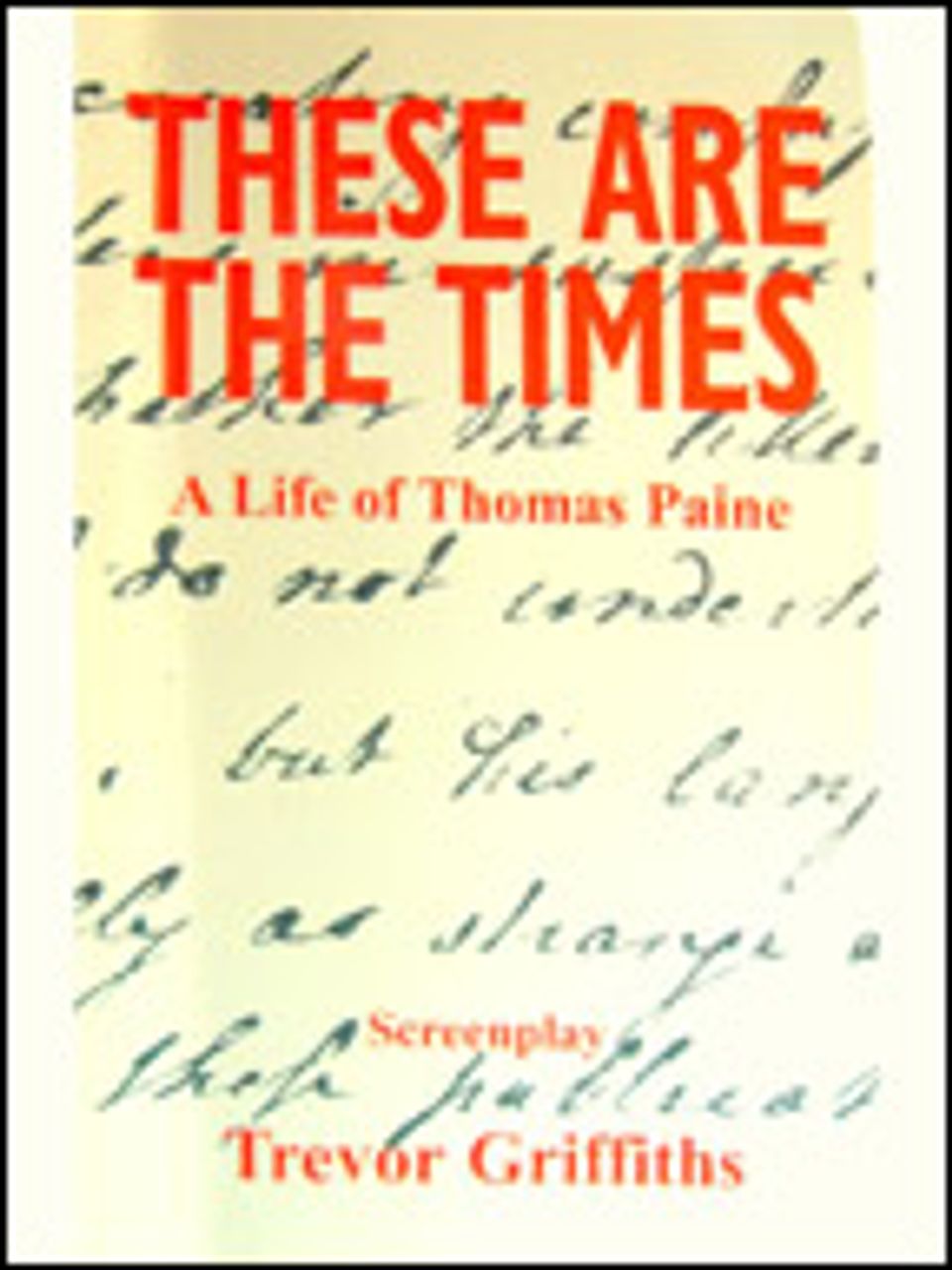
These are the Times: a Life of Thomas Paine, a screenplay by Trevor Griffiths (Nottingham: Spokesman, 2005) ISBN 0 85124 695 8
Screenplays are not often published; they are even less often reviewed. A film is so much the product of a collective effort that a screenplay is regarded as being in some way incomplete until it has been filmed, and yet if the same principle were applied to a play it would seem patently absurd. No one suggests that a play cannot be discussed except in the form of a specific production. We understand the relationship between the screenplay and the film differently because of the vast corporate machinery that is required to make and distribute a film. The writer is dwarfed and seems to be an almost subsidiary figure to the director. But the distinction between screen and stage has no artistic foundation. That becomes clear when we have the opportunity to read a screenplay of the calibre of Trevor Griffiths’ These are the Times. This is a work that stands in its own right as a piece of literature.
Griffiths is perhaps best known for having co-written the film Reds (1981) with Warren Beatty. That film told the story of the American revolutionary John Reed who visited the Soviet Union and wrote Ten Days that Shook the World, an account of the Russian Revolution. Griffiths was nominated for an Oscar for that screenplay and won a Writers Guild of America Award.
Revolution has been a major theme in all of Griffiths’ work for cinema, television and the theatre. His play Occupations dealt with Antonio Gramsci’s role in the Turin factory occupations of 1920. The Party was concerned with the Paris events of 1968 and the reaction to them of a group of intellectuals, writers and artists who encounter the leader of a revolutionary party. It was drawn from life and reflected Griffiths’ own experience in that period. The figure of John Tagg, the revolutionary, was based on Gerry Healy, leader of the Socialist Labour League, then the British section of the International Committee of the Fourth International. Absolute Beginners dramatised the Bolshevik/Menshevik split in the Russian Social Democratic Party. All Good Men concerned the conflict between parliamentary reformism and revolutionary politics that is expressed in the relationship between a Labour Member of Parliament and his son. It was broadcast during the three-day week that the Conservative government of Edward Heath imposed as it clashed with the miners.
Griffiths’ work has been informed and shaped by the political experiences of the working class in Britain. He was born in Manchester in 1935. His father worked in the chemical industry. Griffiths was one of the first generation of working class youth to benefit from the 1944 Education Act. He went to Manchester University where he studied English. He was part of group of new writers including David Mercer, Ken Loach, Jim Allen and Dennis Potter who were associated with Tony Garnett, who brought a new realism to British television in the 1960s. In the theatre, where much of his work has been done, he is one of a group of politicized playwrights that includes David Hare, Howard Brenton and David Edgar.
Yet Griffiths is a distinctive voice among his contemporaries. Whereas many of them seem to want to express a sense of disillusionment, Griffiths resists that prevalent intellectual trend. His writing is never cynical. That is surprising because the disillusionment has a real social basis in the position of intellectuals in capitalist society.
In The Party, John Tagg says to the intellectuals gathered at the house of Joe Shawcross: “In 1919 London dockers went on strike and refused to load munitions for the White armies fighting against the Russian revolution. In 1944 dockers in Amsterdam refused to help the Nazis transport Jews to concentration camps. What can you do? You can’t strike and refuse to handle American cargoes until they get out of Vietnam. You’re outside the productive process. You have only the word. And you cannot make it become the deed. And because the people who have the power seem uneager to use it, you develop this ... cynicism ... this contempt.”
Griffiths’ strength is that he knows what the word can and cannot do. He is aware of the limitations of words, but he has respect for his own craft as a writer. Paine is in many ways the ideal subject for him because Paine was a man of words. He was not like Washington a soldier, or like Jefferson a statesman, although he shared with both an interest in science, and he was certainly not a businessman like Morris. His power lay in his words and their ability to give expression to, and to influence the development of, social consciousness in a revolutionary period. His greatness lay in his willingness to carry on doing that in a period when the revolutionary impetus was temporarily spent.
In another respect too, Paine is the ideal subject for Griffiths. Paine was an Englishman who became a citizen of France and of America. He regarded himself as a citizen of the world. Griffiths differs from many of the representatives of his generation of socialist-minded writers in that he has never been parochial in his outlook, either in a literary or a political sense.
Even when dealing with what might be thought of as British themes, his work has always taken in a wider horizon. His Country, which was a BBC Play for Today, is set in 1945 on the eve of the election that was to bring the Labour Party to power. It featured an English upper class family who find the stables of their country home invaded by homeless people. Within the space of a short and beautifully crafted piece, Griffiths shows how the British political elite adapted to the threat that the working class posed to them and their way of life.
In many ways Country is a quintessentially English piece. That character is emphasised by the way in which it was filmed. It could almost be any one of the nostalgic costume dramas in which British television excels. But Griffiths’ portrayal of the English upper class was influenced by his earlier adaptation of Chekhov’s The Cherry Orchard. His upper class characters have a depth and pathos that takes the drama to the level of serious art and gives to the class struggle in which they are involved an immediacy and intensity that is deeply disturbing. This is not a comfortable evening’s entertainment. The viewer will never take the tour of an English stately home in quite the same way again. Nor will they view post-war British history in quite the same way again. Griffiths reveals the current of class struggle that runs just below the complacent surface of the parliamentary democracy that has dominated the public face of post-war political life.
A great deal of Griffiths’ work for television is now almost unobtainable. His Bill Brand (1976), a Thames Television series about a left-wing Labour MP, and his Food for Ravens (BBC 1997), which was about Aneurin Bevan and the foundation of the National Health Service, seem to have vanished. The BBC commissioned Food for Ravens to commemorate the 100th anniversary of Bevan’s birth, but then refused to network it and restricted it to a late night slot on BBC Wales.
His reputation has been a victim of the continuing rightward trajectory of British politics. Griffiths’ kind of political drama is generally regarded as outmoded. There could be no greater contrast with the late 1960s and mid 1970s. Griffiths’ reputation was then at its zenith. When The Party was first performed by the National Theatre at the Old Vic in 1973, Sir Laurence Olivier played the part of John Tagg the Glaswegian Trotskyist. It played to packed houses and brought Griffiths enthusiastic offers from television.
What the Tom Paine screenplay demonstrates is that even in the present period of eclipse Griffiths’ focus on the guiding themes of his art has not lessened and his powers as a writer have, if anything, sharpened. The screenplay is a remarkable piece of work. Griffiths has always had the ability that a great portrait painter has to get inside the mind of his subject and present the inner essence of that character on the page. In The Party we see a revolutionary leader drawn to the very life. In These are the Times we have the real, living, breathing Tom Paine before us. Paine comes off the page and challenges us.
Paine emerges in a way that no history book or biography has ever presented him. That is no easy task because he was a difficult man, at war with the times that produced him; one of the finest products of his times and yet one of the most reviled. It was not easy for his contemporaries to comprehend Paine’s restless character and it is not easy for us to place him. He remains a revolutionary whether in the eighteenth century or the twenty-first. For Paine the revolution did not end when the British quit America and if he walked in on us today it would not have ended now. His project was world revolution. The injustices and the inequalities that he condemned in the eighteenth century are still with us today and Griffiths’ screenplay makes an explicit connection between then and now.
In the final scene of the film, Paine’s grave lies open and we hear him reading his words from Agrarian Justice. “The contrast of affluence and wretchedness, continually meeting and offending the eye is like dead and living bodies chained together...” Griffiths’ directions run: “The shot tilts suddenly, reveals a modern highway, heavy with traffic, ripping past New Rochelle. Mixes with the south bound flow, to today’s New York City and its images of wretchedness and affluence...”
Paine’s voice continues reading: “...The great mass of the poor are become an hereditary race, and it is next to impossible for them to get out of that state of themselves ... The condition of millions in every country ... is now far worse than if they had been born before civilisation began ...”
The shot returns to the open grave and Paine calls for a “revolution in the state of civilization.”
In this immensely economical scene, Griffiths has summed up both Paine’s revolutionary project and its relevance for today without being in the least didactic. In a matter of a few 100 words that would perhaps make a few minutes of film he has succeeded in creating a self-expanding concept that opens up to fill our minds. We see far more than he presents.
Is there some deception here? We are so accustomed to being manipulated in the cinema it is impossible not to ask. It is surely part of the stock in trade of any competent Hollywood screenwriter to know their way round the levers of human perception. Most use their knowledge in a cynical way. The better ones use it to entertain us. But Griffiths is doing more than even the best of the better screenwriters. Just as he writes characters that are fully human by portraying the essence of their souls, so he allows his audience to be fully human by appealing to what is essential in their social being. Someone coming out of this film would know more about Tom Paine for sure, but they would also know more about themselves.
It is possible that in the present political climate this film will never be made, but it is far more likely that there will come a moment when it has to be made because it will so closely express the consciousness of masses of people. In the meantime, buy the screenplay.
Trevor Griffiths website: http://www.trevorgriffiths.co.uk/
For more information about Griffiths’ film and television work: http://www.screenonline.org.uk/people/id/539442/index.html