
A fully restored version of The Battle of Algiers (1965) is currently screening in selected North American cinemas, with international releases and a DVD to follow later this year. Directed by Gillo Pontecorvo from a script by Pontecorvo and Franco Solinas, the award-winning black-and-white film is a seminal work and probably one of the most powerful films about colonial occupation, and resistance to it, ever made.
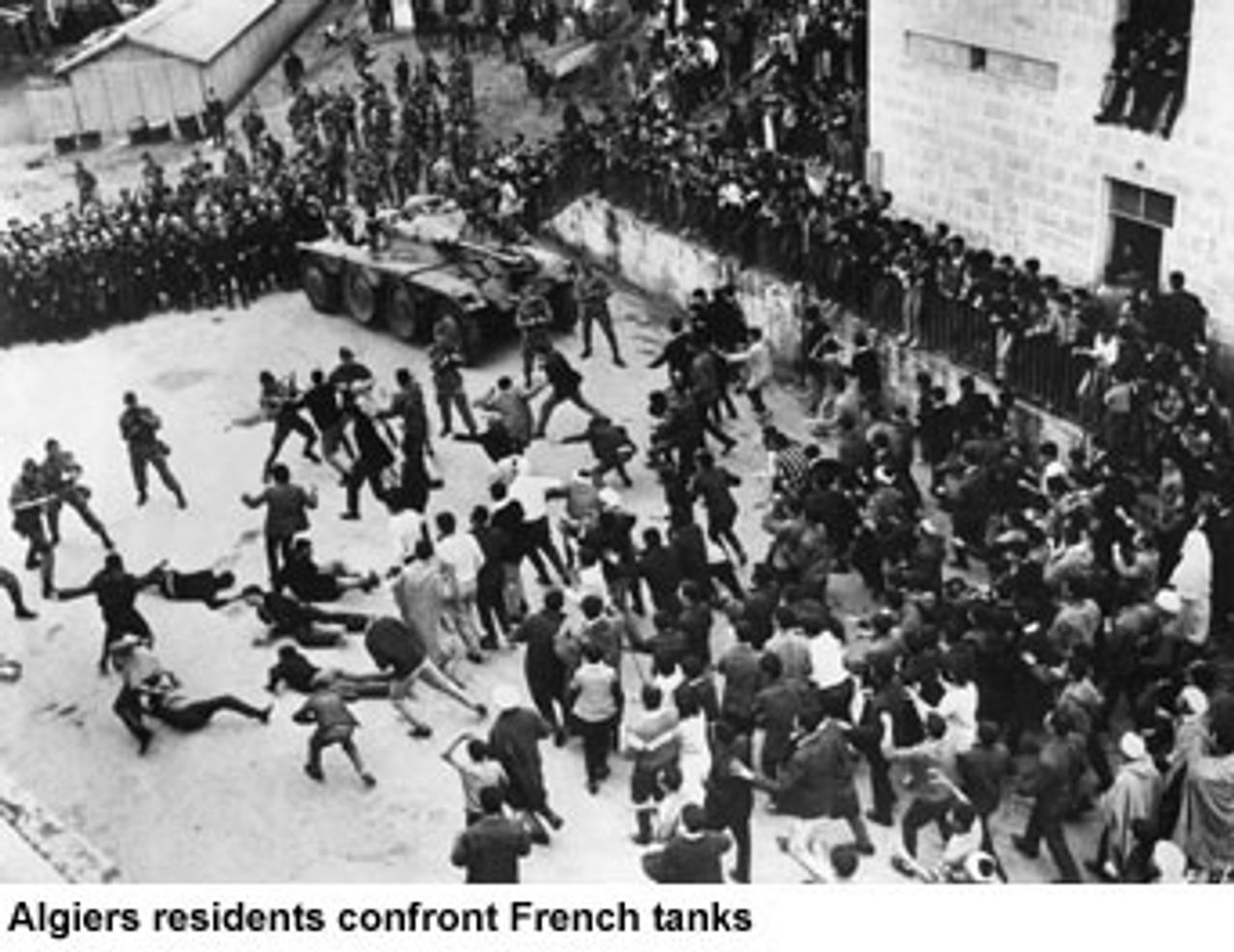 Pontecorvo’s 116-minute movie dramatizes one of the bloodiest anti-imperialist struggles of the twentieth century—the 1954-62 rebellion against colonial rule in Algeria, one of France’s oldest and largest colonies.
During the eight-year conflict the French military and their allied militia killed up to one million Algerians. In Paris, Guy Mollet’s Socialist Party-led government, with Francois Mitterrand as interior minister, passed the Special Powers Act giving the military a blank check in Algeria. Assassination, torture and rape were commonplace. As a leading French general later boasted: “We were given a free hand to do what we considered necessary.”
Tens of thousands of innocent men, women and children were tortured and in Algiers alone more than 3,000 people arrested by French forces “disappeared”. French “pacification” programs forced two million Algerians from their homes, many into barbed-wire concentration camps, and saw the destruction of over 8,000 villages.
Almost two million French troops served in the conflict, including reigning French President Jacques Chirac and Jean-Marie Le Pen, leader of the racist National Front. Le Pen has been accused of being actively involved in torturing prisoners at the notorious Villa Sesini in Algiers in 1957.
While Pontecorvo’s film only focuses on one aspect of the war—the Battle of Algiers of 1954-57—it is a remarkable work. Almost 40 years after its initial release it has tremendous resonance because it demonstrates the modus operandi of contemporary colonial oppression and reveals what gives rise to and fuels a nationalist insurrectionary movement. In fact, the citywide sieges, mass roundups and torture shown in the film prefigure Israeli military attacks on the Palestinians and the methods employed today by US forces in Iraq and Afghanistan. This context, combined with groundbreaking cinematic techniques, skilful casting and an impressive soundtrack composed by Ennio Morricone and Pontecorvo, gives the film an extraordinary authenticity and dramatic intensity.
The Battle of Algiers centres on two main characters: Ali La Pointe (Brahim Haggiag), an FLN (National Liberation Front) member and a symbol of Algerian resistance, and French paratroop commander Colonel Mathieu (Jean Martin), who is appointed to crush the resistance.
La Pointe is from the Casbah, a two-square kilometre, densely populated and poverty-stricken section of Algiers, and a key figure in the armed uprising. Mathieu, who was modelled on Jacques Massu, head of the notorious Paratrooper 10th division, is a cold-blooded representative of the French military, prepared to utilize any means to crush the nationalist movement.
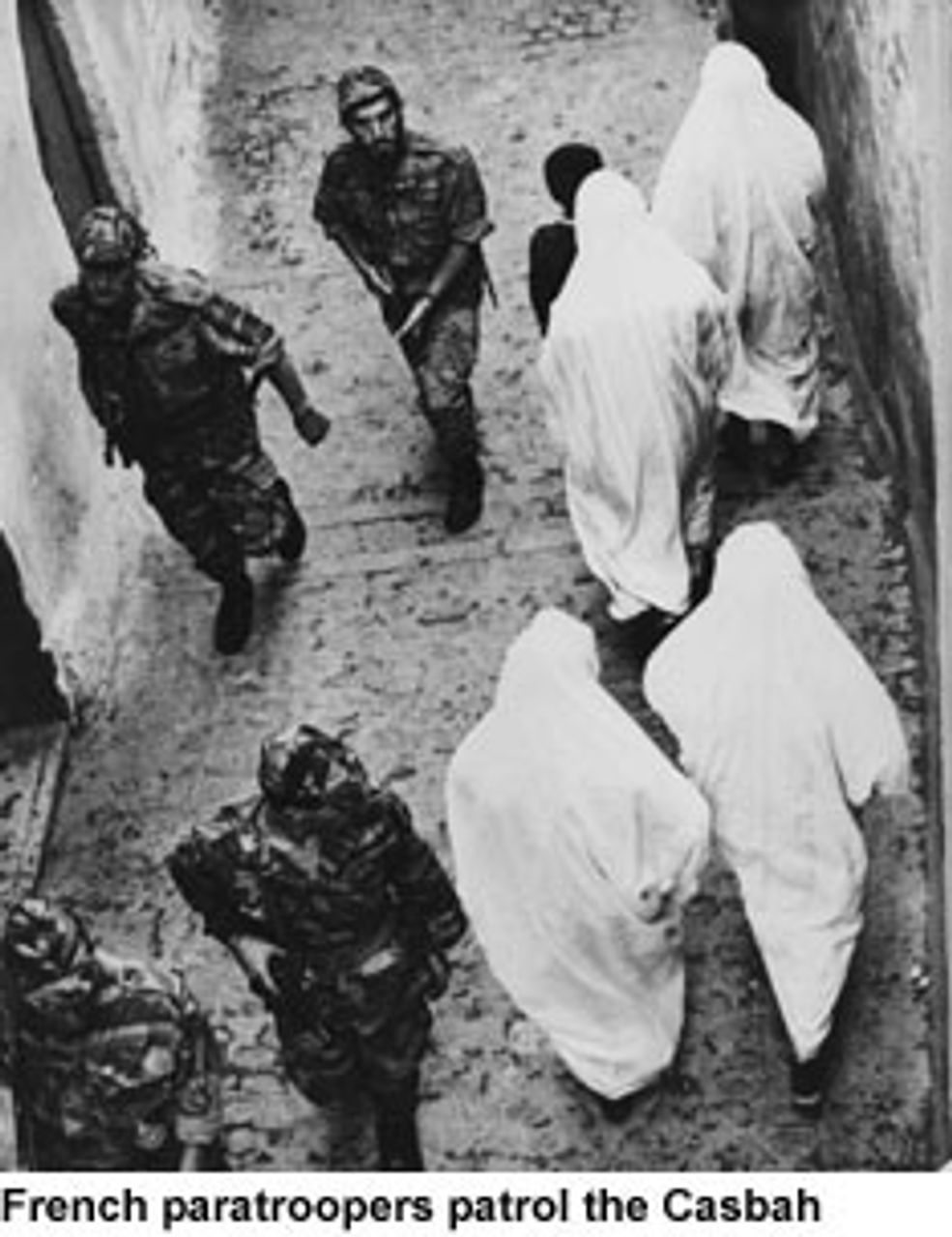 The film opens in 1957. Mathieu and his officers have just forced a confession from a half-naked, unshaven and deeply distressed Algerian. The middle-aged man has revealed La Pointe’s identity and whereabouts. As the movie’s opening credits roll, paratroopers locate La Pointe and three other resistance fighters, including a young woman and 13-year-old boy, hiding inside a secret wall cavity in the Casbah. They are given an ultimatum—surrender or be blown up.
As La Pointe and his comrades ponder their fate, the film flashes back to 1954 when the FLN launched major military operations in Algiers. Adopting a quasi-documentary form, the movie then recreates key stages in the uprising and the political evolution of La Pointe.
La Pointe, a former boxer and petty thief, decides to joins the FLN after witnessing the guillotining of an Algerian resistance fighter by the French colonial government. After testing his trustworthiness and political courage the FLN leadership mobilize La Pointe in a series of audacious but bloody terrorist attacks. French residents respond with midnight bombings and racially motivated attacks.
As tensions increase, paratroopers are mobilized to crush the resistance. Mathieu places the Casbah under martial law with military checkpoints, raids and mass arrests. The FLN reacts with more assassinations and Mathieu unleashes a program of systematic torture and other forms of collective punishment. As attack and counterattack escalate, Casbah women join the FLN and detonate bombs in French civilian areas. But the intensifying French military terror and a failed general strike by the FLN ultimately take their toll and the rebellion is crushed in 1957.
The film ends, however, not with a pacified population but the outbreak, a few years later, of mass demonstrations and a renewed Algerian uprising that eventually forced France to sign the Evian Accords on March 19, 1962, and cede power to the FLN.
In August last year, the Pentagon’s Special Operations and Low Intensity Conflict department decided to show The Battle of Algiers to its employees. This occurred as Iraqi resistance began to intensify its operations against the US military and US Defense Secretary Donald Rumsfeld began to demand “improved intelligence” from its interrogations in Iraq and elsewhere. David Ignatius, writing for the Washington Post, made the preposterous claim that it was a “hopeful sign that the military is thinking creatively and unconventionally about Iraq.” The real purpose of the screening, however, to encourage even more sadistic and illegal attacks on prisoners held by the US army.
Honest examination
While The Battle of Algiers clearly supports the resistance, Pontecorvo’s film is an entirely objective work and does not attempt to romanticize the FLN or its terror methods. In fact, the movie hints at some of the organization’s political weaknesses and contradictions, including its attempts to combine left-wing secular rhetoric with appeals to conservative Islamic sentiments.
A discussion between La Pointe and FLN leader Ben M’Hidi is particularly interesting. M’hidi warns the young recruit that “terrorism” cannot secure victory in wars and revolutions. He warns that revolutionary struggle is difficult, but that winning is “the hardest of all”. And, “only after we have won will the real hardships begin.”
Pontecorvo is brutally honest in his portrayal of the FLN’s terror murders of French civilians but rejects, however, any attempt to establish a political or moral equivalence between the bloody terror of the resistance and the French military. As he told one journalist in 1966, “I think it is insignificant to say ‘they killed ten, they killed two.’ The problem is that they [the Algerians] are in a situation in which the only factor is oppression.... You must judge who is historically condemned and who is right. And to give the feeling that you identify with those who are right.”
This political approach is well demonstrated in one scene when journalists challenge Ben M’Hidi to justify the FLN’s tactics. Is it not “cowardly,” a reporter asks, to use women’s baskets and handbags to launch terror bomb attacks on French civilians? M’Hidi replies by calmly referring to French napalm bombing of thousands of rural villages: “Of course, if we had your airplanes it would be a lot easier for us. Give us your bombers, and you can have our baskets.”
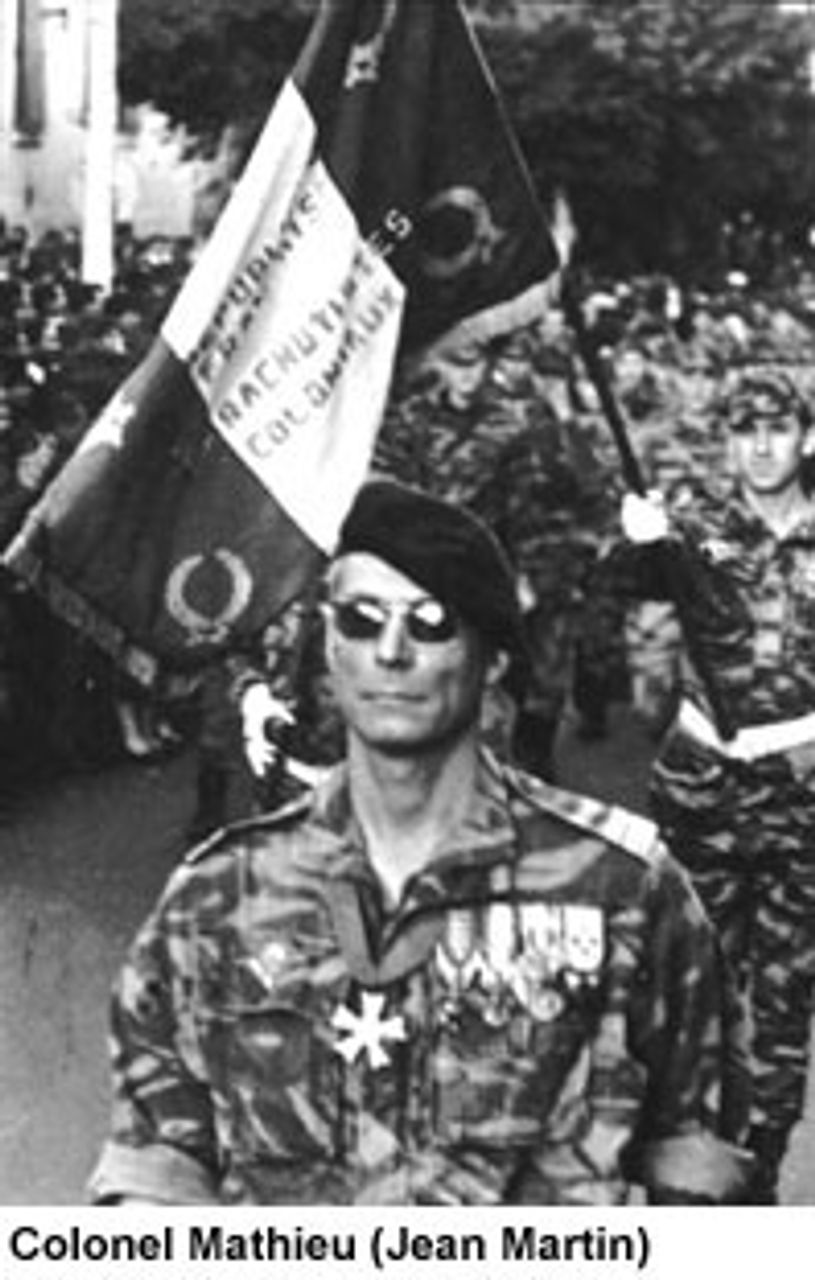 Likewise, Pontecorvo’s portrait of Mathieu is intelligent and avoids exaggeration. In fact, the paratroop commander is the most fully developed character in the film. The highly educated and quietly spoken Mathieu, however, is ruthless in his defence of French interests.
Using phrases echoed today by Washington to justify its “war against terror” Mathieu tells his officers that the FLN is “an anonymous and unrecognizable enemy who mingles with thousands of others who resemble him.” These circumstances, he declares, therefore require that all “humane considerations” toward the resistance be suspended.
Challenged by reporters over his brutal methods, Mathieu replies: “The word ‘torture’ does not appear in our orders... [but] the problem is the FLN wants us to leave Algeria and we want to remain.
“Despite varying shades of opinion, you all agree that we must stay. When the rebellion first began, there were not even shades of opinion. All the newspapers, even the left-wing ones, wanted the rebellion suppressed.... [but] I would now like to ask you a question: Should France remain in Algeria? If you answer ‘yes,’ then you must accept all the necessary consequences.”
The Battle of Algiers demonstrates what these “necessary consequences” involved. Torture scenes with blowtorches, electric shock treatment and the partial drowning of prisoners were censored in Britain and America when the film was first released. The new version of the movie, however, includes these chilling moments. And, like the techniques employed by American military police and intelligence officers in Abu Ghraib and Guantanamo Bay, loud music is used to drown out the terrifying cries of the victims.
Ground-breaking cinema
Born 1919 in Pisa, Gillo Pontecorvo was a member of the anti-fascist resistance, joined the Italian Communist Party (PCI) and was a commander of its Third Brigade in Milan in the last two years of the war. He quit the PCI in 1956, following the Soviet crushing of the Hungary uprising.
Influenced by neo-realist cinema and Russian director Sergei Eisenstein, Pontecorvo decided to become a filmmaker after watching Roberto Rossellini’s Paisan. From 1946 to 1956 he made a series of documentary films, including Pane e zolfo (Bread and Sulphur), about Sicilian miners, and directed his first feature, the underrated La Grande Strada Azzurra (The Wide Blue Road), in 1957. His next feature was Kapò (1960), about a Nazi concentration camp, and followed this with The Battle of Algiers in 1964. After six months’ research and extensive interviews in Algeria and France, he began location shooting in Algiers.
Pontecorvo’s film uses techniques that were innovative for cinematic drama in the mid-1960s and for the first time treats North Africans seriously, rather than figures of ridicule or suspicions, as had previous European and American films. His development of a quasi-documentary form, with newsreel-style narration and captions, 16mm handheld news cameras and the use of FLN and official French military proclamations, were groundbreaking and give the film an electrifying quality.
Audiences are taken inside the narrow alleyways of the poverty-stricken Casbah, with careful recreation of the state repression and racist oppression that eventually provoked the rebellion. Mass demonstrations involving hundreds of people towards the end of the movie are astonishing and have an intensity and urgency that power computer-generated images will never be able to replicate. In fact, the movie’s dramatic realism was so convincing that producers felt obliged to explain during the opening credits that no news footage had been used in the production.
Remarkably, The Battle of Algiers was produced on an $800,000 budget and with only nine qualified technicians, including cameraman Marcello Gatti, on the project. Jean Martin (Colonel Mathieu), who was blacklisted from the French stage in the 1950s for supporting the Algerian resistance, was the only professional actor. The rest of the cast was recruited in Algiers.
Haggiag (La Pointe) was illiterate and had never been to the cinema before he was selected to star in the movie. The middle-aged man who is tortured and eventually betrays La Pointe was temporarily released from an Algiers prison to play his role. Yacef Saadi, who plays Dhile Djafar and La Pointe’s first contact with the FLN leadership, had been a leading member of the resistance and provided the initial story on which the film’s script was based.
While The Battle of Algiers was an immediate success in Algeria, Italy and the US, where it was nominated for three Academy Awards, it was banned in France and Britain until 1971. Former Algerian colonists and the OAS (Secret Army Organization) in France violently opposed the movie. Extreme right-wing elements issued death threats against the families of three cinema managers in France and bombs were planted in some cinemas planning to screen the film. In 1972, a fascist gang attacked audience members, seriously wounding one, at a screening in Rome.
Pontecorvo followed The Battle of Algiers with Burn! (1969), which starred Marlon Brando and dealt with British and Portuguese colonialism in eighteenth century West Indies, and Ogro in 1979 about the Basque separatist movement. None of these, however, matched the intensity of The Battle of Algiers, which became a source of inspiration for directors such as Costa Gavras, Marcel Ophuls and many others.
The film has obvious political limitations. It does not make any reference to the competing factions within the Algerian nationalist movement or show how the nationwide resistance of the Algerian masses influenced the working class in France, which led, in turn, to a wave of strikes and protests against the Charles De Gaulle government. Nor does it deal with the growing antiwar opposition of rank-and-file soldiers from within the largely conscript French army.
Without minimizing or excusing these problems, however, The Battle of Algiers is an intelligent and convincing depiction of the anti-colonial struggle and one that powerfully establishes the legitimate right of the masses in every oppressed country to resist imperialist occupation. Above all, it is impossible to watch Pontecorvo’s movie without recognizing that the US occupation of Iraq and other neo-colonial projects are a reactionary utopia and destined to fail. No matter how vicious or militarily sophisticated, imperialist repression can never suppress or eliminate the democratic aspirations of the colonial masses.