
This is the first in a series of articles on the recent Toronto film festival (September 4-13).
“To produce a mighty book, you must choose a mighty theme. No great and enduring volume can ever be written on the flea, though many there be who have tried it.” Herman Melville
Reality provides so many opportunities to the filmmaker (and the artist in general) for approaching it critically, through drama, comedy, satire, fantasy and other means. Whether or not film artists avail themselves of these opportunities in a serious manner depends on a host of factors, which are not determined, in the first place, by individual strength or weakness.
Artists today face an obstacle course in their attempts to arrive at insightful and truthful pictures of life. Twentieth century history, with its traumas and tragedies, has erected significant ideological difficulties. Over the past two decades or so in particular, on the basis of the supposed triumph of the “free market,” the central axis of modern social life, its class antagonisms, has become unmentionable. This is a serious problem for any truth-seeking artist.
Moreover, the role of money has become so all-dominating that it threatens what remains of the artist’s independence, particularly the filmmaker’s. Giant conglomerates control the “entertainment industry” and largely determine what hundreds of millions of people see on cinema and television screens. Only exceptional figures avoid the corruption of servicing corporate or official interests, on the one hand, or the self-satisfying, but sterile isolation of artistic “purity,” on the other.
On top of that, the critically minded artist faces the growing threat of censorship, legal harassment and physical attack from reactionary governments and political forces around the world, including religious fanatics of various stripes. Rising levels of global popular outrage over social conditions will only encourage right-wing elements, seeking to divert the public discontent, to broaden their assault on intellectual and artistic freedom.
Nonetheless, if the evolution of art “is determined by the evolution of the world,” and unless filmmaking as a whole has been transformed into nothing more than a thoroughly disciplined agency of the status quo (which it has not), painful social truths must sooner or later find expression there.
And we find that this is the case. The most recent Toronto film festival suggests that slowly, quasi-reluctantly, bringing all their often harmful ideological baggage with them, filmmakers as a body, or their better portion, are beginning to come to terms with life as it actually is at the dawn of the 21st century. Film writers and directors are less willing today than five years ago to shy away from treating great social problems confronting broad masses of people and their consequences.
To be more precise, it is not so much that cinema is directly addressing the problems of war (and threats of new and bloodier wars), repression, social inequality and the dire conditions of life experienced by much of humanity. Rather there is an overall growth in humaneness, in sensitivity to suffering, that one cannot help but read as an instinctive, perhaps semi-conscious response to the enormous threat posed by political and social reaction and, in particular, a response to the brutality and criminality of the Bush regime. The latter’s murderousness has begun to arouse and radicalize, one senses, a layer of the artists and intellectuals.
This trend of humaneness takes multiple forms. In a number of cases, film directors treat the humiliations endured by the victims of poverty and social inequality: Jafar Panahi’s Crimson Gold (Iran), Wang Xiaoshuai’s Drifters (China), Marek Lechki’s My Town (Poland). In Rosenstrasse, German director Margarethe von Trotta has created a powerful work about an anti-government protest staged in Berlin in the middle of World War II.
The tragic situation in Afghanistan, both under the Taliban regime and subsequently, is the essential matter of several works, including Siddiq Barmak’s Osama, Samira Makhmalbaf’s At Five in the Afternoon and Babak Payami’s Silence Between Two Thoughts (which was recently confiscated by the Iranian government). Tom Zubrycki movingly documents the fate of Afghan refugees in Australia in Molly & Mobarak. Abjad, an autobiographical work by Iranian director Abolfazl Jalili, celebrates art, love and continual rebellion in the face of the forces of repression.
Israeli directors Ra’anan Alexandrowicz and Amos Gitaï subject their country’s social and moral contradictions to a serious, if limited, examination in James’ Journey to Jerusalem and Alila, respectively.
On a far smaller scale, but with sensitivity that has wide implications, This Little Life (Sarah Gavron, UK) treats the birth of a dangerously premature baby and his parents’ agonizing and illuminating experience over the next weeks.
And there were other generally intelligent films, that adopted a serious attitude toward human problems: Pupi Avati’s comic A Heart Elsewhere (Italy); Marcelo Piñeyro’s Kamchatka, about a family hiding from the military dictatorship in Argentina in 1976; The Galindez File (Spain, Gerardo Herrero), dealing with the collaboration of the CIA and the brutal Trujillo dictatorship in the Dominican Republic in the 1950s; Jonathan Demme’s The Agronomist, concerning the life and death of a Haitian dissident, journalist and broadcaster Jean Dominique; and Robert Benton’s version of Philip Roth’s The Human Stain.
The weakest link of contemporary filmmaking continues to be its lack of perspective, the general absence of a broad sense of historical and social development. This limits the artists, cuts them off from many of the boldest and most original insights. A given social episode or condition may be treated in the most detailed and compelling manner, but its prehistory is nearly always left out of the picture. Whether in large or small matters, almost no explanation is ever offered as to how humanity has arrived at its present condition.
The lack of perspective reaches a hazardous level in the case of a film like Rithy Panh’s S21, The Khmer Rouge Killing Machine. The film treats the horrifying deaths of two million people in Cambodia at the hands of the Pol Pot regime between 1975 and 1979 in a sober and devastating fashion, but is so focused on the details of the barbarism that it provides almost no wider understanding of the sociopolitical phenomenon itself. Several of the films treating the Taliban regime suffer from a similar weakness, running the risk of losing the forest for the trees.
In considering the Toronto festival—which screened 339 films from 55 countries—as a whole, there is naturally no need to paint an overly pretty picture. There is plenty of discouraging rubbish being turned out, and much of the “critical” attention is directed towards it. A certain type of critic or festival attendee unfailingly gravitates to clever and chilly “gimmick” films (The Green Butchers from Denmark, about a pair of butchers who stumble into making meat products out of dead people, Interview from the Netherlands, about an embittered journalist who unwittingly blurts out a “dark secret” to a film star) or cynical and empty ones (such as Purple Butterfly, a travesty of a film, directed by Lou Ye, ostensibly about the anti-Japanese resistance in China in the 1930s).
It is worth noting in passing that none of the festival’s most serious or demanding works received prizes. There is no shortage of dolts in this world, many in responsible positions. And one need only listen to the critic of a highly respected American daily newspaper holding forth to his cronies for an encounter with intellectual poverty not easily equaled.
Crimson Gold from Iran
Jafar Panahi (born 1960) is one of the world’s most respected filmmakers, both for the intrinsic value of his art (The White Balloon, The Mirror and The Circle) and for his integrity.
 In April 2001 Panahi was detained, shackled and chained to a bench by US immigration officials at JFK airport in New York City for 10 hours when he refused to be fingerprinted and photographed because of his Iranian citizenship (part of the “war on terrorism”). This August in a letter to Richard Pena, program director of the New York Film Festival, Panahi explained that he would not attend the festival, where his new film Crimson Gold was scheduled to be shown, because of the “humiliating treatment” meted out to Iranian nationals in the US
The director wrote: “We live in strange times. It’s not just George Bush who subscribes to the idea that you are either with us or against us. In my country, too, anyone slightly crossing any red lines is subject to the suspicion of the censors who label him as being alienated, self-loathing, mercenary, infiltrator, enemy agent, and even heretic. Here [in Iran], they interrogate me because I am a socially conscious filmmaker. In America, they fingerprint me, and literally shackle me to kill my national pride, because I am an Iranian filmmaker. This is the kind of purgatory I, and many others like me, find ourselves in.”
This spirit of opposition animates Crimson Gold. The idea for the film originated in an incident that Panahi and fellow filmmaker Abbas Kiarostami read about in the news: a thief, trapped by the security system inside a jewelry store, killed the store manager and then himself. Panahi explains, “I became obsessed with this story. I asked myself what could have pushed a human being to such an extreme. Abbas ended up writing a screenplay about this incident, with the intention of tracing the events leading up to it and discovering how and why such a horrifying thing could occur.”
Such incidents take place every day—and not only in Iran. But not many filmmakers concern themselves with these everyday tragedies, much less their social roots.
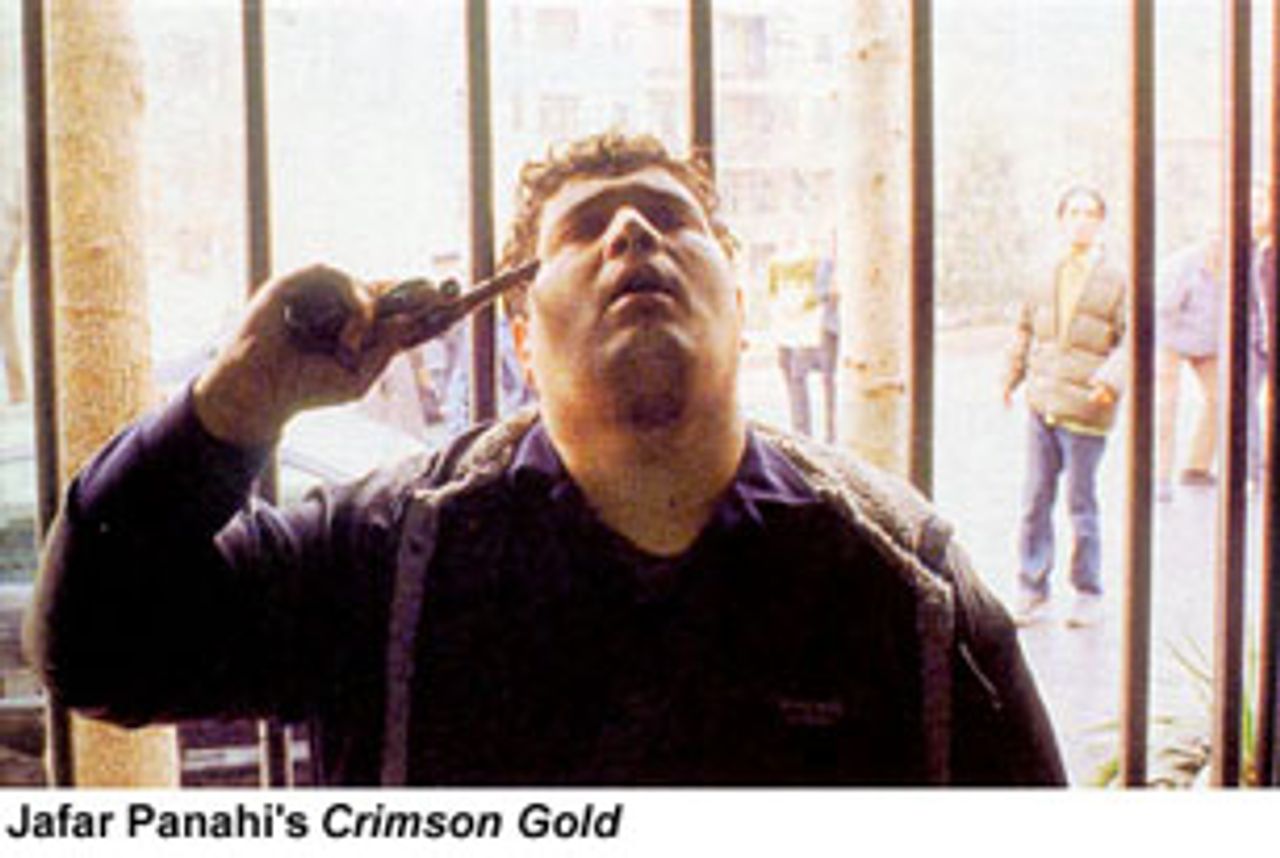
The film opens with the denouement, the murder-suicide, and then recounts the events that preceded it. Hussein, the eventual “thief-murderer,” makes a miserable living delivering pizzas in Tehran. A large, unhappy-looking man, Hussein is on medication for an unspecified illness perhaps contracted during his service at the “front lines” in the Iran-Iraq war of the 1980s. Life has deeply wounded him. He has nothing, he barely speaks.
His friend, Ali, is relatively carefree. He makes a little extra money through petty crime. From a purse that he “found,” Ali retrieves a receipt for a necklace. The amount (“75 million”) stuns Hussein, who will never be able to afford such an item. Hussein is planning to marry Ali’s sister. The two men try to gain entrance to a jewelry store in an upscale neighborhood, but are turned away because of their scruffy appearance.
During his delivery rounds Hussein encounters injustices of another kind. At night the paramilitary wait outside an apartment building and arrest young people leaving a party where the sexes have mingled and danced. Forced to wait, Hussein offers a slice of pizza to a hungry young recruit (15, the boy has lied about his age), who refuses because of what his superiors might think. To get around that, Hussein hands out the food to everyone on the scene, officers and family members alike. Now the boy can have something to eat.
Hussein and Ali dress up, and return to the store, with the prospective bride. Their treatment is slightly better this time, but still the store manager sees them for what they are, poor men. “He didn’t even look at us,” Hussein exclaims. He has an attack. Riding home with him on his motorbike, the anxious young woman says, “I was so happy to see you like that, in a suit and tie. I thought, ‘He’s better, we can get married soon.’” He’s not better, in fact, he’s worse.
Hussein is driven over the edge by an encounter with a wealthy young man to whom he tries to deliver pizza. The young man, Pourang, at first turns him away, explaining that the food was for a couple of girls, “two sluts,” who have walked out on him. Then he invites Hussein inside, offers him a drink and the run of his palatial apartment as he raves on about how little he understands Iran and Iranians. Pourang has recently returned from exile; his parents are still in the US. A call on his cell phone interrupts their conversation. Hussein wanders alone through the extraordinary residence, complete with a gym, a fireplace, a giant television, an indoor swimming pool! Fully clothed, Hussein jumps into the inviting blue water.
In the following scene, Hussein pulls a gun on the manager of the jewelry store. The climax of the tragedy unfolds.
Panahi says that his main intention “is to tell a story honestly and objectively.... It’s up to the viewer to reflect and interpret what I present on his or her own. I expect my audience to be willing to reflect.”
Crimson Gold is one of the strongest Iranian films in years, perhaps since the mid-1990s. Few films in recent memory from any country have dealt so directly and incisively with the consequences of alienation and social polarization. After undergoing something of a decline in recent years, the Iranian cinema seems to have found new life, drawn from both the country’s economic and political crisis and the tragic events in Afghanistan and Iraq.
“Why are you doing this?” the store manager asks Hussein. “He’s crazy,” say people in the crowd outside. But Hussein, the “thief-murderer,” is a victim of a cruel and hypocritical social order, one that punishes its young people for alleged sins while the elite enriches itself at the population’s expense. As a vulnerable human being, someone who has nothing, not even mental stability, his action is not so inconceivable. Kiarostami and Panahi have managed to put a human face on this lowest of the low, this pariah. And without sentimentality or overdramatizing. Hussein is a product of his society, and his society is ultimately to blame for the tragedy.
The artist has to do this kind of work, to explain essential matters to the public, to illuminate the most troubling and complex questions. This, above all, contributes to revolutionary social change. Too few writers and directors are playing this role at present, for which the film world should be ashamed of itself.
At the public screening, Panahi pronounced himself an “independent and socialist moviemaker. I make films from the bottom of my heart. My conscience never lied to me.” How many contemporary filmmakers can say the same?
Margarethe von Trotta’s Rosenstrasse
Rosenstrasse, or The Women of Rosenstrasse, as it may be called in English (the film was picked up for distribution by Samuel Goldwyn Films at the Toronto festival), is perhaps director Margarethe von Trotta’s strongest work since Rosa Luxemburg. The film took eight years to organize and finally make.
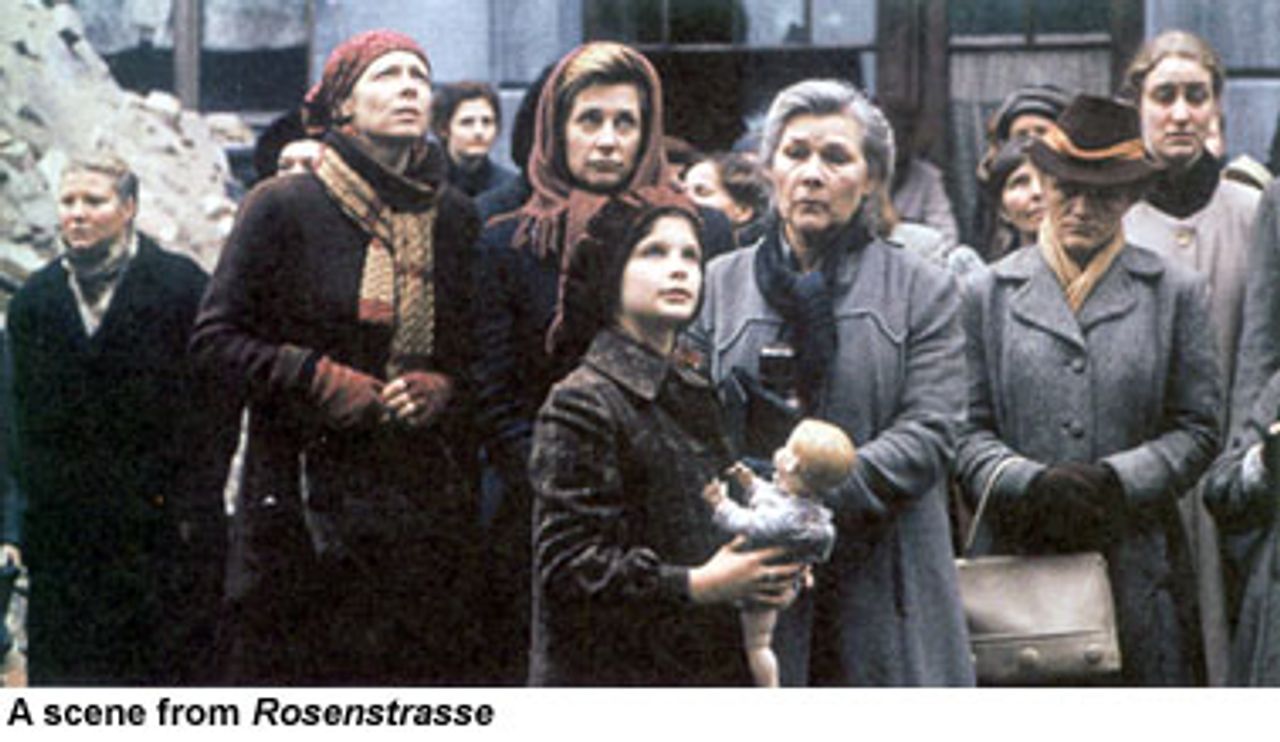
It relates a little-known episode that occurred in Germany in late February and early March 1943. The Jewish spouses of “Aryan” wives and husbands, after being protected hitherto, were suddenly rounded up by the Nazi regime. Deportation and death in concentration camps confronted them. A spontaneous demonstration by hundreds of wives broke out on Rosenstrasse, the Berlin street outside the detention center where the Jewish prisoners were being held. The women defied the authorities, who eventually trained machine-guns on them. In the end, an extraordinary thing happened.
To tell her story, von Trotta (born 1942) invents fictional characters and sets her work in several different time periods. In modern-day New York City a Jewish woman, Ruth (Jutta Lampe), who has just lost her husband, unexpectedly marks religious traditions which she has never observed before. Her daughter, Hannah (Maria Schrader), is slightly unnerved and tries to get to the bottom of her mother’s transformation. She sets out to learn about Ruth’s past, which has always been something of a mystery. The search leads her to Berlin and the non-Jewish woman, Lena Fischer (Katja Riemann), who took Ruth in as a child when the latter’s mother was deported and murdered by the Nazis.
At the center of the film is Lena’s struggle in the winter of 1943 to win the release of her Jewish husband, Fabian (Martin Feifel), from the detention center on Rosenstrasse. In a flashback, we see the progress of their relationship—he, a gifted violinist; she, a pianist from an aristocratic family. Her family disapproves violently of the match. Lena, Fabian and her brother (Jürgen Vogel) haunt Berlin night-clubs, dance to jazz and black singers. An extraordinary social and cultural moment is recreated. Anti-Semitism, the Nazi menace, seem very distant.
As the political situation deteriorates, the Fischers’ economic and moral condition worsen. They live in a small apartment, everything is taken away from them: career, instruments, music itself. Fabian is forced to work in a munitions plant. Eventually he is arrested. Lena’s brother returns from Stalingrad, having lost a leg. He takes a leading role in seeking Fabian’s freedom. “I know what they do to the Jews. I saw it,” he tells a fellow officer. Lena’s appeals to her family and to a high-ranking Nazi official are “desperate” and fruitless. Meanwhile she has “adopted” Ruth, whose mother has already been deported, thanks to her “Aryan” husband’s having divorced her out of fear and weakness.
The demonstrations on Rosenstrasse become more vocal and aggressive. It is an astonishing moment when the women shout, “Give us our husbands back!” and, later, “Murderers!” The troops fire in the air. The woman scatter and reassemble. Perhaps they have nothing to lose. Perhaps they know that the defeat at Stalingrad means the end of the war and the end of the regime. In any case, they are very brave.
Von Trotta’s film is deeply principled and humane. Whether it is consciously intended to or not, Rosenstrasse delivers a blow to the arguments of those who claim that the crimes of the Nazis expressed the will of the German people. The filmmaker does not avoid the harshest realities, but she keeps her eyes on reality as a whole. German culture flowered in the 1920s, in anticipation of a social revolution that never took place due to the criminal betrayals of the Social Democratic and Stalinist parties. The brief night club scene, when the cultures, “high” and “low” and “races” mingle in an almost ecstatic instant of freedom, provides a glimpse of this possibility. To suggest that the Nazi regime was the inevitable outcome of German history becomes inarguable even on the basis of this short sequence. This is entirely to von Trotta’s credit. She shows that art can indelibly establish objective truth in the face of lies and slander.
There are less successful features to the film. The past-present framework is somewhat predictable, and the scenes in New York rather stiff and not entirely convincing. Von Trotta, an actress herself, is perhaps not the finest director of actors. One feels that those who have strong personalities, thrive in her films. Those she must guide are less successful. Riemann and Vogel make the strongest impression in Rosenstrasse.
Von Trotta’s film was one of the high points of the Toronto festival.
To be continued