
The current exhibition of bronze sculpture at the Art Gallery of Ontario (AGO) in Toronto cast from the works of French artist Edgar Degas (1834-1917) is a welcome opportunity to study the often overlooked sculptural achievement of that great artist. Regarded as one of the most influential painters of the modern period, his sculpture, though less known, is an equally vital contribution to the impressionist movement of the late 19th century and in its bold expression forms a pivotal development in modern sculpture.
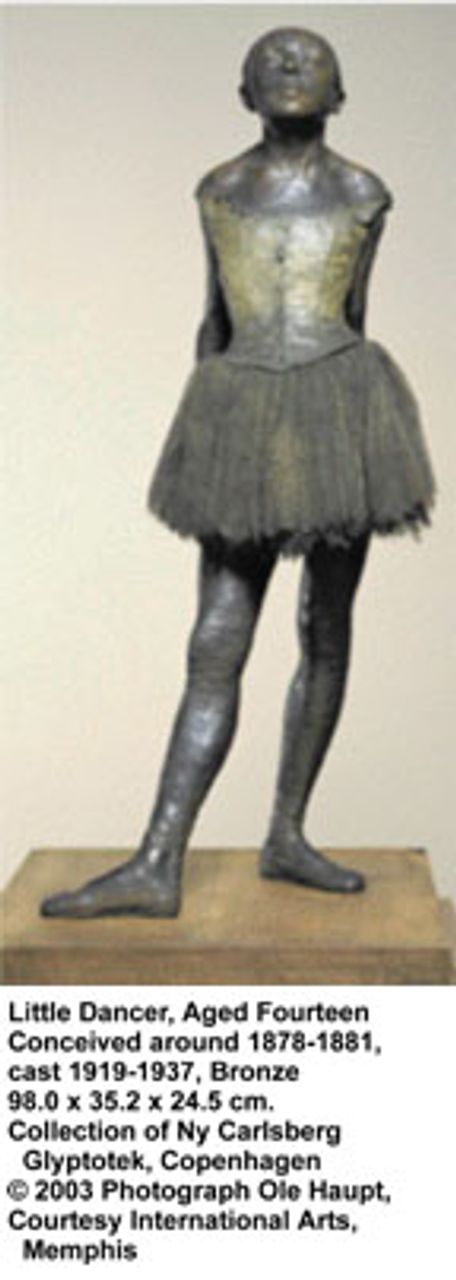 The current show of 76 bronzes, which includes three pieces from the AGO’s own collection, presents one of only four complete sets of the castings of Degas’ sculpture in existence; this one from the Ny Carlsberg Glyptotek—a prominent sculpture museum in Copenhagen. These works treat the same subjects and themes as the artist’s paintings and drawings—principally dancers and horses in movement, which conservators have said “represent the height of Degas’ experimentation in both technical and aesthetic realms.” [1]
The very existence of these bronzes has been a matter of debate virtually from the time of the artist’s death in 1917. Degas never authorized any of his sculptures to be reproduced in bronze, so it was left to his heirs and others to balance his wishes against the need to preserve his work.
Leaving the issues of authenticity and authorization aside for the moment, it would be worth considering the historic significance of this artist and his peculiar development. In his public as well as his personal life, Degas embodies high contrast and contradiction. His work represents perhaps one of the strongest links between the conservatism of the old and the revolutionary spirit of the new in the upheavals that dominated his era.
Although Degas was one of the central figures in the development of the impressionist school of painting and he participated in their annual exhibitions from 1874 to 1886, there are some important distinctions between his work and others of that school. Impressionism in the characteristic work of artists such as Monet, Renoir and Sisley is virtually defined by their treatment of the open-air settings of their paintings and the liberating exploration of natural light. In largely shunning outdoor settings, Degas’ work is markedly distinguished from the rest of this school, and his particular themes of the ballet, horse racing, and nudes at bath and toilette set him apart from his contemporaries in subject matter as well.
Although Degas is best known and acclaimed for his drawings and paintings, artists of such stature as Renoir also declared him to be the greatest sculptor of his epoch. This, despite the fact that during his lifetime he publicly exhibited only one, the classic of modern sculpture known as “Little Dancer, Aged 14,” and only in the wax original. The work shown in this exhibition could rightly be termed sculptural studies—most are just over a foot high—yet they reveal a brilliance on par with his two-dimensional work. Though better-known sculptors such as Rodin or Matisse are generally credited with the great advances in modern in sculpture, the significance of Degas in that discipline only became apparent after his death.
The bourgeois artist
Degas grew up in a privileged banking family, his father originally from Naples and his mother a French Creole from New Orleans, where the artist visited and worked during a later period in his life. Born Hilaire Germain Edgar de Gas in 1834, the eldest of five children, he seems to have had, if not an unhappy, at least a colorless childhood. Early in his education, he chose to depart from the traditional course of schooling laid out for him, and after studying law for a year convinced his father to allow him to pursue artistic training, which was virtually unheard of for someone of his social position.
Early in his career, Degas distinguished himself by his mastery of drawing skill, which he refined during extended stays in Italy where he had family. He developed what was to be a life-long admiration for the work of Jean-Auguste-Dominique Ingres, from whom he learned the importance of drawing as the basis of painting, and this influence was manifest in the bold use of line in his own work. Not surprisingly, his sculptural works carry through this boldness in capturing the tensions and possibility of animal and human movement. As art historian Germain Bazin wrote in 1931, “For Degas [sculpture] is the definitive conquest over space... Degas’ statuette cuts into space, tears at it in every direction.”
The artwork of Degas represents a break from the formalism of the “Academic” style prevalent in France when he came of age; signifying a process in the world of art bound up with the profound political and cultural upheaval taking place in Europe in the latter half of the 19th century. At the same time, perhaps more than any of his contemporaries, his work embodied the preservation of artistic tradition and technique, his early years having been spent studying and copying the works of the great masters. Degas took what was best from the neoclassical school of painters such as Ingres, which was then passing out of favor, and from the radical advances represented by the realism of Courbet, leading him ultimately to the revolutionary innovations that collectively contributed to what came to be known as “impressionism.”
Before Degas had established himself in the art world or was able to make a decent living from his work, his father died, leaving the family in dire economic straits in 1874. This was not long after his tour of duty in the Franco-Prussian War of 1870-1871 and the Paris Commune, during which workers seized and held power for several months. Degas was supportive of the Commune, although he was not publicly outspoken in his political views. What progressive social views he held during this time are, however, in sharp contrast to his evolution as a strident anti-Semite in his declining years.
Degas began to lose his sight around this same time and it mysteriously continued to deteriorate to the point where he was functionally blind for the last 15 or so years of his life. As a result, he became increasingly withdrawn and, by the turn of the century, indifferent to the success he had garnered. His death on September 27, 1917, went virtually unnoticed, overshadowed as it was by the ongoing war. As one historian commented, it was perhaps a fitting end for a man who had once said, “I would like to be famous but unknown.”
Degas as sculptor
There is some evidence that Degas did not view his sculpture as much more than a means to refine his understanding of subjects and to work through problems for his paintings. He was concerned with grasping the essential qualities of movement, both human and equine, and was very much affected by the photographic studies of horses done by Eadweard Muybridge, who was his contemporary. Degas was himself a significant innovator in artistic technique and took great interest in the startling advances in photography at the time. It has been suggested that as his eyesight deteriorated over the last half of his life, he turned more to sculpture for his artistic expression. However, he always maintained that he had sculpted for most of his life, and this appears to be the case.
It is unclear following the showing of “Little Dancer” precisely why Degas never exhibited his sculpture again, although a number of explanations have been advanced. The reception of this singular work elicited a great deal of criticism as well as praise, and the stir created by its inclusion in the impressionist exhibition in 1881 may have itself been offensive to Degas.
The wax figure, which is about two-thirds life-size, is striking even today in various ways. There is a disturbing allure in the enigmatic expression of a girl on the threshold of adulthood; eyes half closed in a pugnacious, upward gaze, struck in a carelessly haughty stance, arms stretched behind her, foot forward; the pose itself was regarded as highly audacious. The unusual use of garments and other materials—the dancer is adorned with a real tutu, bodice and shoes—all flew in the face of convention to the point where some critics took great umbrage at the showing.
Yet Degas was not one to court public opinion—he evinced an outright contempt for unquestioning conformity—and so it seems unlikely that the critical storm raised by his first sculptural exhibition would have discouraged him from further showings. Whatever his reasons, and they were seemingly manifold and as contradictory as his personality, it remains a fact that he chose not to either exhibit or cast any but one of his sculptures—a choice that ultimately involved in controversy, as well as benefited, those who were left to manage his sculptural legacy.
The question of the unauthorized reproduction of Degas’ sculpture has at least two sides to consider. On the one hand, it is generally recognized that had his works not been preserved in bronze or some other lasting material, they would have effectively been lost. The materials of the originals—clay and wax—are not durable and have degraded with time. On the other hand, it is doubtful that the artist ever intended the pieces to be cast in bronze. Although there is evidence that he had prepared some of his works for casting, the consensus is that he wished the rest to pass out of existence with him.
According to a journalist of the time, François Thiebault-Sisson, Degas was explicit about the fate of his sculptural studies: “From this day forward until my death, this will all be destroyed by itself and this will be best for my reputation.” It should also be noted that many of the works that were cast were found crumbling and neglected on the floor and shelves of the artist’s studio. Fewer than half of the 150 works that were retrieved following his death were deemed suitable for casting, and many of those are of a decidedly inferior quality.
In any case, there was agreement among his heirs that the works should be distributed in limited bronze editions, although the number and manner became a matter of dispute. This initially was fueled by rivalries and other family differences, but ultimately took an openly mercenary form. The highly respected Hébrard foundry was entrusted in 1918 to manage casting and distribution of the works, but in subsequent decades the foundry seems to have deliberately exceeded the contractual limits of the edition, in one case casting more than double the number of authorized bronzes. Nevertheless, bronze castings are considered originals in cases such as this where the working model is ultimately destroyed, meaning that, despite their shady provenance, the works in this exhibition have a legitimate claim to authenticity.
Contradiction and controversy
Politically, Degas was well known for his anti-Semitic views, which surfaced during the Dreyfus Affair of the 1890s. The persecution of this Jewish French officer revealed the official racism of the ruling class in France—and behind that, the spectre of reactionary anti-Republican forces deeply hostile to the working class and its socialist evolution—and sharply divided European society. In siding with the anti-Dreyfusards, Degas evinced views that are in sharp conflict with the intensely humane portrayals in his art. In contrast to his racial bigotry, in his paintings and sculpture there is an unmistakable democratic spirit that reveals a compassion and identification with the struggles of everyday life.
Such disturbing contradictions often characterize privileged social layers driven by a narrow and blinkered fear of personal ruin. In her essay “Degas and the Dreyfus Affair: A Portrait of the Artist as an Anti-Semite,” art critic and historian Linda Nochlin suggests that the precarious social position of Degas and his family had much to do with his reactionary views. “Anti-Semitism served not only as a shield against threatening downward social mobility but as a mechanism of denial, firmly differentiating Degas’ fragile haut bourgeois status from that of the newly wealthy, recently cultivated upper-class Jews whose position was, to his chagrin, almost indistinguishable from his own.”
To explain is not to condone. Degas apparently subscribed to and read scurrilous publications, not so dissimilar in their diatribes from fascist rags some decades later. While these facts do not detract from our view of Degas as an artist, they certainly affect our view of him as a human being. How to reconcile this ugly reality with the humanity of his art remains a troubling and unresolved question.
In addition to his anti-Semitism, Degas’ attitudes toward women are often described as misogynistic. In his sculpture, as in his painting, there is an ambiguity in his depiction of his female subjects, never demeaning or overtly prurient, but which often captures them in moments of simple vulnerability—as though they were unaware of the artist’s presence while grooming or in repose.
Degas was a life-long bachelor, and his condescension toward the opposite sex was well known; yet he seemed to regard the young women who modeled for him with great affection and amusement. Although many of the dancers who modeled for him commonly came from impoverished circumstances, there is no evidence that he treated them with any disrespect. In sculptural studies such as “Woman washing her left leg,” the figure is set in a decidedly unromantic pose, bent and straining, tenderly caught in a private moment. Here he reveals an identification with his subject and empathy for her vulnerability.
The exhibition at the AGO, which runs until January 4, 2004, has drawn legitimate criticism for obscuring the origin of this sculptural exhibition out of concern for its potential as a crowd-gatherer. Despite the high praise accorded the artist in the various gallery publications, their less-than-honest stance on this score has not helped matters. Notwithstanding this and other secondary matters, a viewing of Degas’ works on its own merits offers a truly compassionate view of humanity.
Note:
1. Shelley Sturman and Daphne Barbour, “The materials of the sculptor: Degas’ techniques,” Apollo 142 (August 1995): 54