
Marcus Bonser’s testimony
Rear Admiral Bonser, a serving officer of the RAN, became director general of Coastwatch, a division of the Australian Customs Service, in August 2001. In his testimony of May 22, 2002 to the Senate inquiry he declared that the primary function of Coastwatch was to “conduct coastal and offshore surveillance in order to generate information on potential or actual breaches of legislation as they relate to Australia’s maritime zones.” Coastwatch passed that information, including signals traffic, on to “relevant client agencies,” including Defence, enabling them to “make informed decisions on whether further action is warranted and, if so, the nature and extent of that action. Under Operation Relex, Bonser explained, Coastwatch operated “in support of Defence”—“a reversal of the arrangements that normally apply to civil surveillance matters in Australia’s maritime zones.”
In his opening statement to the inquiry, Bonser not only confirmed the six intelligence reports about SIEV X mentioned in Smith’s “letter of clarification”. He declared that Coastwatch had received information “as early as August 2001 that Abu Qussey was allegedly in the process of arranging a boat departure of illegal immigrants, probably to Christmas Island. In the ensuing period, Coastwatch received information that the vessel was expected to depart, or had departed, Indonesia on four different dates in August, anywhere within a seven-day block in September and on five separate dates in October.” eHe said that “information in relation to possible boat departures from Indonesia is often imprecise and subject to frequent change.”
What his testimony did, however, was provide conclusive evidence that SIEV X had been under constant surveillance for nearly three months. He also revealed that the source of the intelligence was the Australian Federal Police, and that the information received by Coastwatch was routinely passed on to Operation Relex, accompanied by “a précis of the relevant information in its daily operation summary message.”
Bonser explained that Coastwatch had issued the “overdue” notice on October 22 on the basis of previous advice from the Australian Federal Police as to when the boat had departed.
Questioned about whether it would be standard practice to send a plane to where a boat was reported to be leaving, Bonser replied: “The whole general area is being covered by what is probably the most comprehensive surveillance that I have seen in some 30 years of service.” (Emphasis added.)
Despite this “comprehensive surveillance,” and the constant flow of information specifically about SIEV X, Bonser was unable to explain why it dried up right at the time the SIEV X sank.
After Bonser’s opening statement came the following extraordinary exchange.
Senator Bartlett (Democrats): I noticed in your statement—in paragraph 43—that you said you got advice on the 22nd [October, 2001] that [SIEV X] was overdue and you notified Search and Rescue. On the 23rd, you got advice from Australian Theatre Joint Intelligence Centre that a SIEV had sunk. Later that day, CNN... reported the sinking and the rescue of survivors. Was that the first time you or any of the Australian operations were aware of survivors being located—hearing it through CNN?
Rear Adm Bonser: Yes, it was.
Bartlett: So we have got a comprehensive surveillance operation, the strongest we have ever had, and CNN could find out what was happening before we could?
Bonser: In this case the vessel clearly was not detected prior to its sinking.
Senator Faulkner (Australian Labour Party): Do you know why not?
Bonser: No, I do not.
Faulkner: Have there been any inquiries at all—internal Commonwealth inquiries—into this issue since the sinking that you are aware of?
Bonser: I do not know of any.
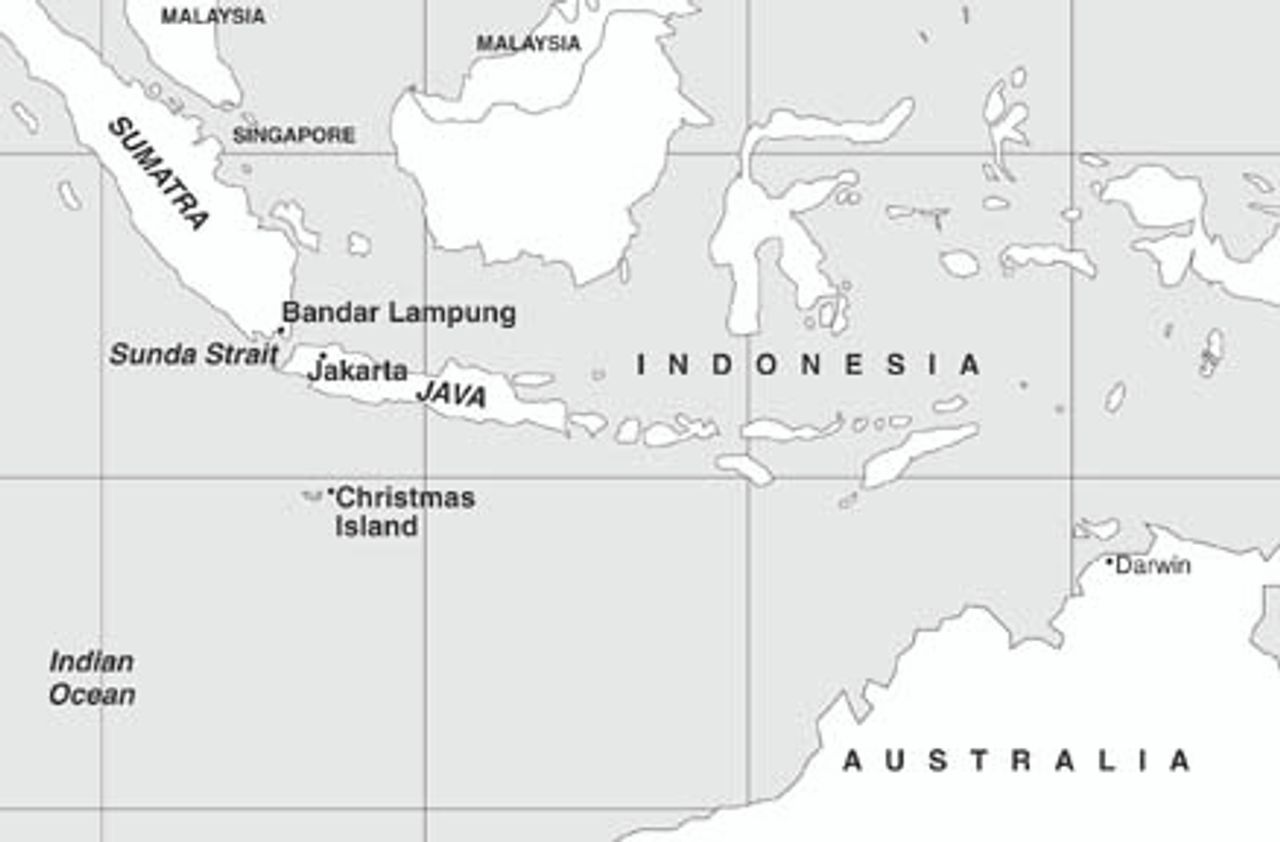
Bonser also testified that the most probable location of the sinking was “somewhere between the Sunda Strait and perhaps 80 miles south of Sunda Strait, or 80 miles south of Java”—an area, he said, that was “under surveillance from Defence and not Coastwatch” during Operation Relex. “They had ships with helicopters and aircraft there,” he added.
Later, he told the senators that the limit of Defence (ADF) surveillance was “about 30 miles south of Indonesian territory” and that Tony Kevin’s estimation of where the boat foundered “would be within the surveillance area.”
Despite this, Bonser maintained throughout that there was no “course of action that any Australian authority could have taken that would have prevented the sinking of the vessel.” He said he “disagreed” with Kevin’s allegations.
In response to further questions, Bonser admitted that Coastwatch had made no requests of any of the agencies with the capacity to detect radio communications from boats or aircraft in the area at the time “to check to see if anything they retain indicates that messages or broadcasts were intercepted by them.”
In other words, despite the greatest loss of life at sea in the immediate vicinity of Australian territorial waters in living memory, (approximately equivalent to the crashing of a jumbo jet full of passengers) not a single government agency or department conducted an investigation into how it happened or who was responsible. No review was made of the information available at the time, or why it was that the 353 victims were not rescued. In recent years, drownings of fishermen and yachtsmen have, correctly, triggered coronial inquests and Senate inquiries. Extensive and costly searches have, also correctly, been mounted for a single missing yachtsman. At the very least, Bonser’s astonishing admission meant that the lives of 353 asylum seekers were considered to be simply not worth the effort of an investigation. The only other conclusion was that the government and the navy had something even worse to hide.
Admiral Chris Ritchie contradicts Smith and Bonser
Two weeks later, on June 4, the incoming chief of the navy, Admiral Chris Ritchie, appeared before the inquiry to attempt to save the day for the government. With Smith’s initial testimony shot to pieces by Bonser, the navy’s top official tried to smooth over the contradictions.
At the outset, Ritchie disclosed that, during the month of October, there was actually a great deal more intelligence reporting on SIEV X than either Smith or Bonser had divulged. Other agencies had also sent messages to the navy about the boat on October 10, 11, 12 and 14. Like Smith and Bonser, Ritchie was at pains to emphasise that the information was, nevertheless, inconclusive.
Unlike Smith, however, Ritchie testified that under Operation Relex the navy did not send out ships to intercept SIEVs once reliable information about their departure had been received. “We put ourselves between the archipelago and Christmas Island,” he said, “and we waited for these people to come through those particular areas. All of the boats that we detected, that is how we detect (sic) them; they came through the area that we sat in.” Therefore, he told the senators, “there was no reason, no cause, nor, indeed, no right for Admiral Smith...to send ADF assets into the area where the boat subsequently foundered and disappeared.” (Emphasis added.)
Ritchie went even further. Directly contradicting the evidence of both Smith and Bonser, he said that Operation Relex “does not specifically trigger surveillance activity because surveillance activity is there.” According to Ritchie, ongoing surveillance took place, irrespective of the intelligence forwarded to the ADF. Aircraft were not sent to specific areas to look for SIEVs, they simply conducted general surveillance. Moreover, he testified—again contradicting Bonser—that air surveillance was not conducted in the area south of the Sunda Strait. That made it impossible, he said, for anyone involved in Operation Relex to have detected SIEV X. He went so far as to declare that SIEV X “is not a SIEV, as far as we are concerned.”
Ritchie also informed the Senate that, contrary to Bonser’s evidence, there had, indeed, been an inquiry into the sinking of SIEV X and the intelligence surrounding it. “There has been a review of all the intelligence that was received in a chronological order. All it shows is that there was considerable confusion as to where this boat departed from, when it departed, how many people were in it and whatever.”
But—strangely—when asked when the review was launched, Ritchie replied: “I do not know the answer to your question as to when it was done.”
How to account for this? Indeed, how to account for the totally contradictory evidence supplied by three leading naval officers? In this relation, it is noteworthy that Ritchie had only recently been appointed by Prime Minister Howard as the navy’s new chief. Was Ritchie’s evidence which, taken together, placed the navy’s role in the best possible light, just another high level cover-up? Was this an attempt at damage control in the face of potentially explosive admissions by Smith and Bonser?
What Howard’s PST knew
Asked in the course of his testimony on May 22 whether the matter of SIEV X had been discussed at meetings of the Howard government’s People Smuggling Taskforce prior to October 22, when Coastwatch issued the “overdue” notice, Rear Admiral Bonser replied: “No, I am not aware of that at all.” At the same time, he confirmed that Coastwatch was represented at all PST meetings.
Bonser’s evidence dovetailed with that of Jane Halton, Howard’s handpicked head of the PST. On April 16, Halton indicated—without going into the matter in any detail—that the committee knew nothing about SIEV X until October 22, three days after it sank and two days after its survivors were rescued. But on June 15 the PST’s minutes were published, after the Senate ordered their release. They revealed that the interdepartmental committee discussed SIEV X at six successive meetings between October 18 and October 23. At the very first discussion on October 18, the minutes show that the committee had information on that SIEV X had departed for Christmas Island and that there was “some risk of vessels in poor condition and rescue at sea.” The intelligence was described as “multi-source information with high confidence level.”
The PST was set up in September for the specific purpose of monitoring and directing Operation Relex. It was charged with making all operational decisions concerning the interception and boarding of SIEVs. The revelation that the taskforce was in receipt of high level intelligence about SIEV X’s departure and its unseaworthy condition on the day it departed raises the obvious question: why was the navy not instructed to intercept the boat? Why was no aerial surveillance ordered?
The answer is not that information about the boat was simply passed over. On October 20 the minutes note that SIEV X was expected to arrive the next day. On October 21 there is a very odd entry: “Check Defence P3 [Orion aircraft] is maintaining surveillance over Christmas Island.” (Emphasis added.) So the PST, it seems, had directed that surveillance be carried out—perhaps the day before—but why near Christmas Island? Since the boat was known to be “in poor condition” and potentially in need of “rescue at sea” why was surveillance not ordered further back, closer to the Sunda Strait, which was still well within the ADF’s general surveillance area?
By October 22 the minutes indicate that the PST assumed the boat had sunk. The chilling minute reads: “SIEV 8: not spotted yet, missing, grossly overloaded, no jetsam spotted, no reports from relatives.”
Clearly, the committee expected “jetsam” and “reports from relatives.” The obvious question is: if Halton and her colleagues were anticipating a disaster, why didn’t they take action to avert it? Who made the decision not to? There is no question but that Howard and his closest political allies would have regarded a rescue at sea of 400 refugees, three weeks before the November 10 poll, as an electoral disaster. Did the committee (or someone outside it) therefore decide to simply ignore SIEV X?
Significantly, in the October 22 minute, the boat was referred to as “SIEV-8”—as opposed to Ritchie’s evidence that it was “not a SIEV, as far as we were concerned.” This further confirmed that the boat had been clearly identified and was being tracked by the PST.
The next PST minute on SIEV X was dated October 23. It reported the committee receiving an account of the testimony of SIEV X’s survivors (the same testimony accessed by Tony Kevin). The minutes conclude: “Vessel likely to have been in international waters south of Java” when it went down.
It is inconceivable that the PST would have failed to immediately brief Howard on the details it had gathered of the boat’s fate. The PST’s October 23 meeting took place a few hours before CNN’s first public report of the drownings. Yet, contrary to the information contained in the PST minute, the prime minister declared on that very day: “This boat sank in Indonesian waters. We are not responsible.”
The publication of the PST minutes exposed the extent to which virtually every witness called before the Senate inquiry up to then had consciously withheld evidence or lied outright. As Kevin pointed out in an article in the Australian Financial Review on June 21: “These minutes show that such information was available in the defence system, and to the AFP and departments such as immigration and foreign affairs [all of whom had representatives on the PST—LT]. Many officials in member agencies, briefed by their departmental representatives at PST meetings, must have known since April that false testimony was being furnished to the committee. With the exception of Bonser, none came forward. Even after Bonser, the system tried to sustain the claim that not enough had been known about SIEV X to warrant a search...”
A further “clarification” from Bonser
One week after the release of the PST minutes, Rear Admiral Bonser appeared again before the Senate inquiry to expand upon his May 22 evidence. In his first appearance, he had confirmed the six intelligence reports outlined in Rear Admiral Smith’s letter of “clarification”. Included among them was the intelligence received by Coastwatch at 9.30am on October 20: that SIEV X had set sail and that it was “small and with 400 passengers on board, with some passengers not embarking because the vessel was overcrowded.” At that time—9.30am—SIEV X’s survivors had been desperately clinging to life vests and planks in the ocean for some 18 hours, after witnessing hundreds of their co-passengers, including their children, other family members, friends and colleagues lose the battle to stay alive.
Bonser now testified that an Australian Federal Police officer (later identified as Kylie Pratt) had personally warned Coastwatch that the boat was grossly overloaded and feared it was in grave danger of sinking. Moreover, Coastwatch relayed this information on to Defence before 10am on October 20.
Yet, with highly reliable information that hundreds of refugees’ lives were immediately at risk, both Coastwatch and the navy concluded there was no “definitive assessment that the vessel had departed Indonesia.” Coastwatch therefore decided not to alert the search and rescue authorities and the navy decided not to alert the HMAS Arunta, lying 150 nautical miles south, (about four hours away) or any of its helicopters or P3 Orion surveillance aircraft. Moreover, as we already know, the PST’s minute of October 21 made clear that Howard’s committee itself had already directed that aerial surveillance be kept to Christmas Island and was adamantly insisting that it remain there.
To be continued